
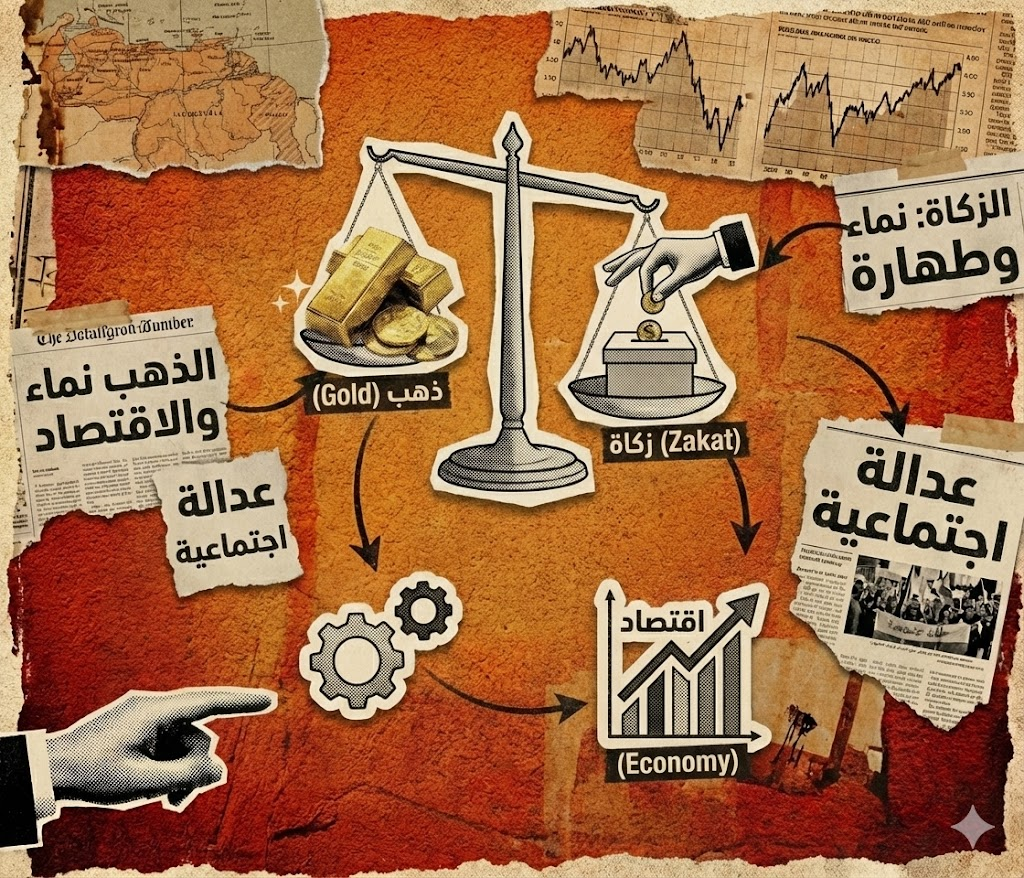
Inflation can reduce what a cash payment buys. Whether a particular payment retains its purchasing power depends on how its amount changes relative to the prices of the goods and services the recipient needs. A rise in gold is one possible influence when the underlying wealth is held in metal; it is not an automatic protection for every zakat payment.
Three quantities should remain separate
The eligibility threshold for an obligation, the value of wealth being assessed and the purchasing power of a payment are different quantities. Using a metal value to discuss a threshold does not mean that a person's cash balance has risen with that metal. It also does not establish how the recipient's living costs have changed.
A deliberately hypothetical example
Assume, solely for arithmetic, that the applicable payment is 2.5% of an assessed amount. If that amount is 10,000 currency units, the payment is 250. If the assessed amount later becomes 11,000, the payment becomes 275. These are invented values in a single unspecified currency, not observations of gold prices in 2025 or 2026 and not a determination that any person's zakat is due.
Compare the payment with a defined basket
Suppose a local basket of essential goods initially costs 250 units. If its price later reaches 262.50, the hypothetical payment of 275 buys more than one basket. If the basket instead costs 287.50, the same payment buys less than one. The result depends on both changes, not on the payment's nominal increase alone.
Gold can move differently from living costs
Metal prices and local food, housing or energy costs do not follow an identical path. Exchange rates and the timing of valuation matter as well. A gold price increase over a selected period cannot establish protection across every household, currency or future period. The opposite scenario, in which gold declines while living costs rise, must remain possible.
Economic explanation and religious determination
The example illustrates purchasing-power arithmetic only. The applicable threshold, assessment basis, timing and treatment of particular assets require the relevant religious determination for the actual circumstances. This article does not instruct readers to convert savings into gold, choose a particular threshold or calculate a personal obligation from the illustration.
A more precise conclusion
To assess the real value of a payment, identify its amount, date, currency and the relevant local price basket. A higher asset valuation may increase a payment under particular assumptions, but neither that relationship nor a metal-linked threshold guarantees protection from inflation.
Editorial update — November 11, 2026: Revised to correct overgeneralizations and remove unsupported investment instructions and assurances. The original publication date is retained.
Leave a Reply