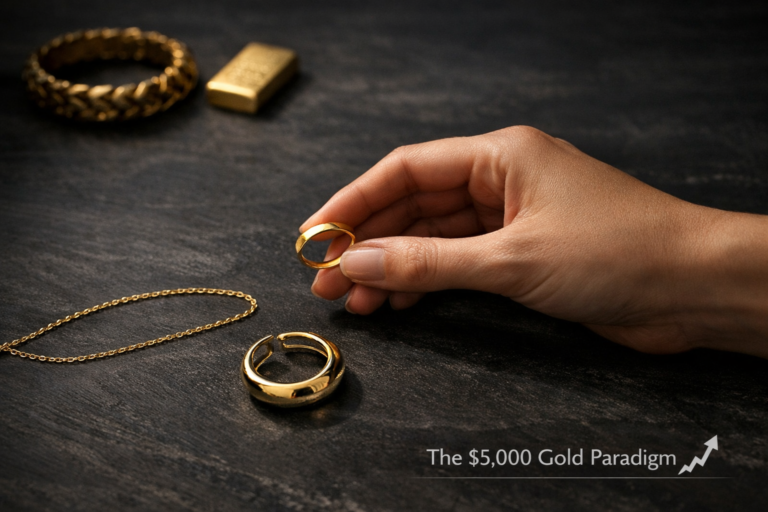
The arrival of gold at the pivotal $5,000 per ounce threshold represents a watershed moment in the history of the “king of metals.” This price level has not only reshaped the strategies of major investors but has also triggered a seismic shift in the dynamics of the jewelry trade, fundamentally altering consumer behavior and traditional manufacturing methods.
As a leading independent research body, Dhbna Caliber has analyzed the multifaceted impact of this new reality. This report delves into the structural changes transforming the industry, moving it from a market of simple luxury to one of sophisticated financial intelligence.
A Shift in Consumer Psychology: The Rise of “Investment Adornment”
At the $5,000 per ounce mark, traditional heavy-karat gold jewelry has moved beyond the financial reach of many in the middle class. This has led to a radical transformation in the purpose of purchasing, eroding the demand for “social gold”—pieces bought primarily for ostentatious display.
Instead, a new consumer mindset has emerged, focused on what can be termed “smart adornment.” Today’s buyers are increasingly drawn to pieces that masterfully blend aesthetic appeal with ease of liquidation. The primary consideration is now a low craftsmanship premium, ensuring the maximum possible value is recovered upon resale. This shift underscores a deeper understanding of gold essentials, where the intrinsic value of the metal is paramount.
The Karat Revolution: A Strategic Move to Lower Karats
To maintain affordable price points, the industry has witnessed a dramatic change in the hierarchy of gold karats. This strategic pivot is crucial for keeping the allure of gold accessible.
| Karat | Traditional Role | Current Status & Rationale |
|---|---|---|
| 21K | The dominant choice in the Arab region for decades. | In decline. Its high gold content makes it too expensive for intricate, lightweight designs. |
| 18K | A popular mid-range option. | The New Mainstream. Its superior hardness allows for more delicate and complex designs with less weight, offering a perfect balance of purity and affordability. |
| 14K & 9K | Previously considered secondary or “low-end.” | Strategic Luxury. Now being adopted by high-end jewelry houses for fashionable collections. They offer the appearance of gold at a cost that can be 40-60% lower than high-karat alternatives. |
This evolution is not a compromise on quality but a strategic response to a new economic environment, a topic often explored in our gold price analysis section.
Engineering Value: The Boom in Hollow Jewelry and Material Integration
To counter the high cost of raw gold, manufacturers have turned to advanced engineering and design innovations.
- Hollow Jewelry: The most significant trend is the rise of “hollow” or “voluminous” jewelry. Using technologies like 3D printing, manufacturers can now produce pieces that appear large and substantial but are incredibly lightweight and hollow on the inside. This delivers the bold aesthetic consumers desire without the corresponding weight and cost.
- Material Integration: Another key strategy is the integration of gold with other materials. Designers are increasingly using ceramics, high-tech enamel, and semi-precious stones to add volume, color, and texture to a piece without increasing its gold content. Proper jewelry care for these mixed-material items has become an essential piece of knowledge for the modern owner.
The Ascent of Strategic Alternatives
The soaring price of gold has paved the way for other noble materials to capture a share of the adornment market.
- Gold Vermeil: This has emerged as a legitimate and chic alternative for social and everyday wear. It consists of a thick layer of high-karat gold (typically 18K) electroplated over high-quality sterling silver, offering a durable and luxurious finish.
- Other Precious Metals: There is a noticeable shift towards platinum, especially in the bridal sector for its durability and prestige. For more contemporary and avant-garde designs, colored titanium is also gaining traction as a fashionable and cost-effective choice.
Dhbna Caliber’s Outlook: The Future of the Jewelry Trade
Based on these developing trends, our team foresees the following key features shaping the future of the sector:
- Recycled Gold as a Primary Source: The circular economy will become central to the industry. Individuals will increasingly trade in their old, heavier pieces for newer, more contemporary designs, making recycled gold the most sustainable and economically viable source for manufacturers.
- The Dominance of Minimalism: The trend of “less is more” will continue to grow. The focus will be on minimalist, delicate designs where the value lies in the creativity and idea behind the piece, not its gram weight.
- Bifurcation of Gold Ownership: Consumer awareness is growing that jewelry is not the most efficient vehicle for pure investment. This will lead to a split in purchasing habits: consumers will buy gold bars and coins for savings, while opting for lower-karat gold, silver, or vermeil for personal adornment.
Summary
The advent of the $5,000 per ounce gold price has not killed the jewelry industry; it has reinvented it. The market no longer measures beauty in grams alone but in a sophisticated calculus of design value, technological innovation, and financial prudence. Gold jewelry has transcended its role as a mere consumer good to become a liquid, strategic asset, even when worn on the wrist of the everyday consumer.