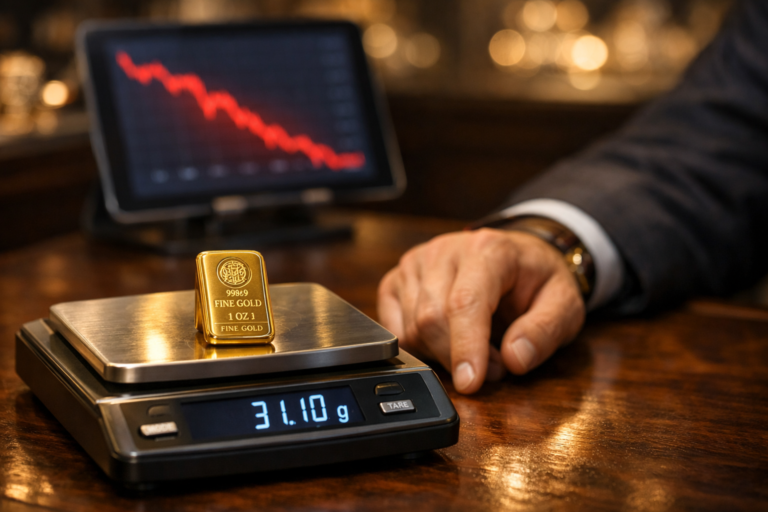
Investors in emerging gold markets, particularly in regions like Egypt, frequently encounter a perplexing question: why does the officially quoted global gold price differ so markedly from the actual price at a local jewelry store? At Dhbna, we posit that this variance is not arbitrary nor the result of manipulation. Instead, it is the logical outcome of the “risk management mechanics” that retail merchants must employ to survive in a highly volatile market.
This article dissects the components of this price gap, offering a clear view into the operational realities of the physical gold trade.
1. Global Spot Price vs. The True “Landed Cost”
The price flashing on international screens represents the “spot price” of a raw ounce of gold on global exchanges like London or New York. However, for that ounce to reach a customer’s hand, its cost accumulates through a multi-layered formula. The final retail price, or “landed cost,” is a composite figure.
The following table breaks down the journey from the screen to the store:
| Cost Component | Description | Impact on Final Price |
|---|---|---|
| Base Spot Price | The international market price for one troy ounce of raw gold. | The starting point for all calculations. |
| Logistical Costs | Expenses related to shipping, insuring, and clearing the gold through customs. | Adds a direct, tangible cost per unit. |
| Taxation & Tariffs | Includes Value-Added Tax (VAT) and other administrative duties imposed by the state. | A mandatory percentage increase on the value. |
| Premium & Profit | The cost of fabrication (craftsmanship or “masna’eya”) plus the retailer’s margin. | Covers business operations and generates profit. |
| Hedging Premium | An additional buffer added to insure the retailer’s financial position against sudden, adverse price movements. | A crucial risk management layer in volatile times. |
Understanding these layers is the first step in appreciating why the local price is structurally higher than the international quote. These are fundamental principles covered in our Gold Essentials category.
2. The Bid-Ask Spread: A Market’s Defensive Shield
In stable market conditions, the difference between a retailer’s selling price (ask) and buying price (bid), known as the “spread,” is typically narrow, often between 1% and 2%. However, during a crisis, this spread widens dramatically, sometimes reaching 5% or even 10%. This is not arbitrary; it is a defensive mechanism.
- During a Buying Frenzy: When public demand surges, retailers raise their selling price significantly. This serves two purposes: it tempers the rush, helping to protect their limited inventory from being depleted instantly, and it prices in the higher risk and cost of restocking in a frantic market.
- During a Selling Panic: Conversely, when the public rushes to sell their gold, retailers lower their buying price. This protects them from the immediate risk of a continued price collapse. If they buy gold at a high price only for the market to fall further, the loss is immediate and direct.
3. The “Risk Buffer” and Extreme Volatility
When the gold market experiences sharp volatility—swinging 3% to 5% within a few hours—pricing based on the “live screen” becomes a fatal risk for a merchant. If a shop buys gold from a client at the current market rate and the global price plummets an hour later, it absorbs the entire loss. To guard against this, retailers resort to two primary tactics:
- Expanding the Safety Margin (Buffer): They deliberately widen their bid-ask spread to create a larger cushion against potential intraday price drops.
- Temporarily Halting Purchases: In moments of extreme uncertainty, many will suspend buying operations altogether until the price trend shows signs of stabilization.
While our focus here is on market mechanics rather than predictive forecasting (a topic explored in our Gold Price Analysis section), understanding this response to volatility is key to interpreting market behavior.
4. The Cash Flow Conundrum
Liquidity is the lifeblood of any market. In countries like Egypt, physical cash flow can become a significant constraint for retailers. In such a scenario, even if the global gold price is attractive for a purchase, a shop might:
- Refrain from Buying: Simply because it lacks the available cash to complete the transaction.
- Offer a Lower Price: Quote a price significantly below the market rate, not because the asset isn’t valuable, but because their immediate liquidity position is weak. The lower price reflects the high cost or inability to source cash at that moment.
Dhbna’s Guidance for the Prudent Investor
Based on the mechanics outlined above, the Dhbna editorial team offers the following strategic advice:
- Adopt a Comparison Strategy: In times of market stress, never rely on a single quote. Compare prices from at least three to four different retailers before executing a transaction.
- Favor Investment-Grade Bullion: For long-term savings, prioritize low-premium assets like gold bars and coins. Ornate jewelry, while beautiful, loses a substantial portion of its value upon resale due to high craftsmanship costs that are rarely recovered. For those who own such pieces, proper Jewelry Care is essential to maintain their condition.
- Understand the Nature of the Market: Accept that a wide price spread during a crisis is the “tax” paid for the privilege of immediate liquidity in a tense and uncertain environment.
For further inquiries or to understand our data practices, we encourage you to contact us or review our Privacy Policy.
Summary
The gap between the screen and the shop price is not a sign of a broken or manipulated market. It is a rational, predictable “safety valve” that reflects a retailer’s comprehensive assessment of risk and liquidity. The local price is not based on abstract numbers on a screen but on the tangible costs and immediate dangers of operating a physical business in an unpredictable world. This price difference, while frustrating for investors, is precisely what ensures the physical gold market can continue to function, providing vital liquidity even in the most challenging of times.