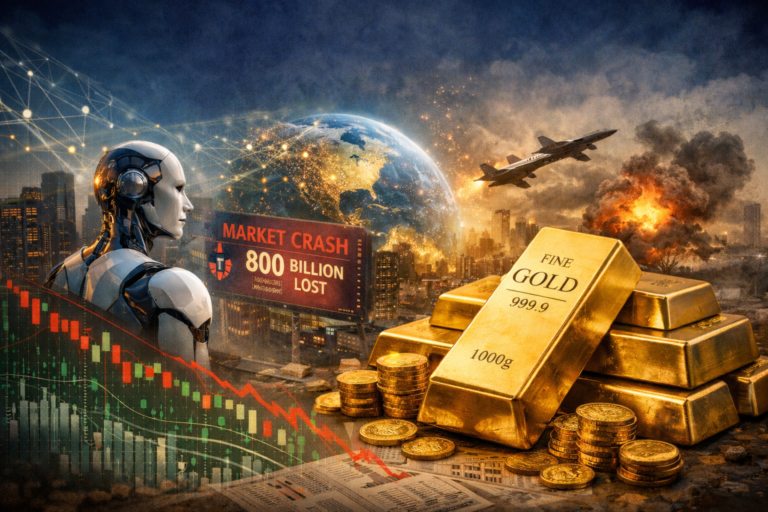
The global financial landscape is witnessing a seismic shift. According to the latest Kobeissi Letter report, equity markets have shed nearly $800 billion in market capitalization amid growing fears that artificial intelligence will erode profit margins across traditional industries. While the report heralds what it calls the greatest productivity expansion in history—dubbed “Abundance GDP”—our research team at Dhbna identifies a fascinating paradox: this digital revolution is simultaneously creating conditions that elevate gold’s strategic importance in ways few anticipated.
The Commoditization of Cognition and Physical Asset Renaissance
The Kobeissi report introduces a compelling concept: AI is “commoditizing cognition” in the same manner the internet commoditized distribution and personal computers commoditized computing power.
What does this mean for tangible assets?
When knowledge-based services—legal advice, financial planning, software development—become abundant and inexpensive through AI tools, capital naturally gravitates toward absolute scarcity. Gold, as a physical asset that cannot be algorithmically generated or digitally replicated, emerges as the definitive benchmark for stable value in an era where intellectual labor faces deflationary pressure.
| Asset Category | AI Impact | Scarcity Status |
|---|---|---|
| Knowledge Services | Rapidly Commoditizing | Declining Value |
| Digital Assets | Infinitely Replicable | Variable |
| Physical Gold | Production-Constrained | Absolute Scarcity |
This fundamental distinction positions gold uniquely within modern gold essentials discussions.
Gold Under “Abundance GDP”: The Deflation Hedge
The report proposes that AI-driven productivity could reduce living costs faster than income declines, effectively increasing households’ real purchasing power—a phenomenon termed “Deflationary Abundance.”
Two critical implications emerge:
First, massive financial surpluses generated during this abundance era require secure storage vessels. With technology sector margins under compression, investors seek alternatives beyond volatile equities.
Second, trust erosion accelerates. As Ray Dalio previously warned, and as the report’s discussion of collapsing SaaS business models suggests, confidence shifts away from companies dependent on “paper promises” and threatened future earnings toward assets possessing intrinsic, standalone value.
Geopolitical Dimensions: Abundance or Sixth-Stage Conflict?
The Kobeissi analysis presents an optimistic thesis: abundance ends wars because historical conflicts originated from scarcity of energy, food, and technology.
Our perspective differs. This optimism collides directly with Dalio’s “Sixth Stage” framework. Even if AI generates abundant resources, the intensifying “capital warfare”—asset freezes, technological sanctions, payment system exclusions—heightens nations’ need for physical gold that cannot be:
- Programmatically disabled
- Algorithmically blocked
- Digitally frozen by foreign decree
Central banks understand this reality intimately. Their accelerating gold acquisitions reflect not nostalgia but strategic preparation for fragmented monetary systems.
Investment Implications for Prudent Portfolios
The structural transformation described in “Will AI End the World?” arrives whether we embrace it or resist it. While major corporations face margin compression, discerning investors recognize a timeless principle: material scarcity commands premium value when intellectual abundance prevails.
The balanced portfolio Dalio advocates—traditionally 30% equities, 20% gold—gains renewed relevance. Equities capture productivity gains; gold shields against transitional chaos and paper value erosion.
For those building long-term positions, understanding proper jewelry care and authentication becomes equally essential as market timing.
Summary
The AI revolution creates a profound paradox for asset valuation. As cognitive services become commoditized and digitally abundant, physical scarcity—exemplified by gold—gains strategic premium. Whether “Abundance GDP” materializes as predicted or geopolitical friction intensifies, gold remains the singular constant in an accelerating equation of change.
Adaptation distinguishes crisis from opportunity. Our continued research explores these dynamics in our gold market coverage.