
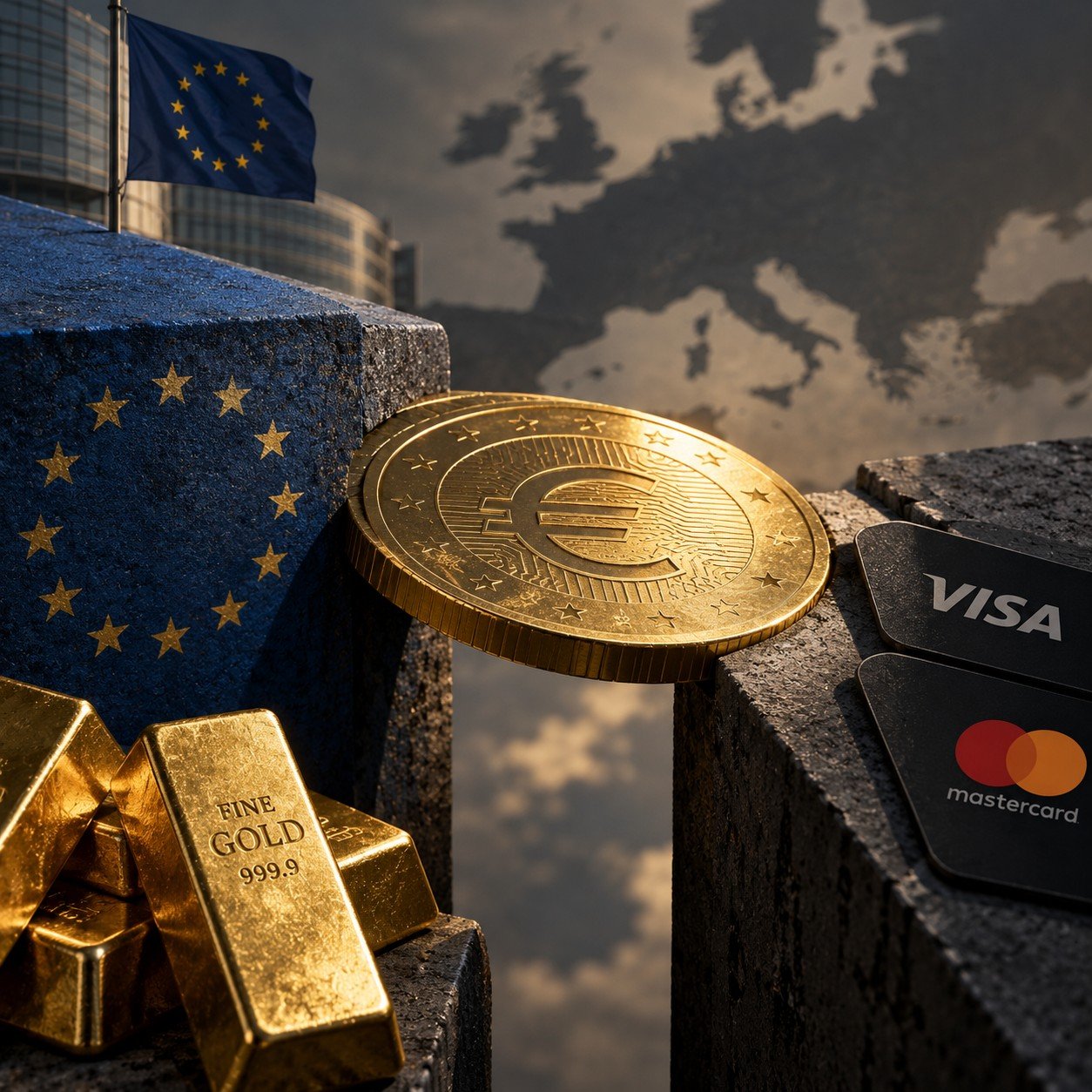
Europe wants a payments infrastructure less dependent on US companies. For gold investors, however, the important question is not whether Europeans can pay without Visa or Mastercard. It is whether the transition changes demand for currencies, reserve assets and protection against monetary risk. That is the meaningful connection between the digital euro and gold—and it requires more than a headline.
The central finding: the digital euro is a project to modernise money and payments, not a gold-backed currency or evidence of new bullion buying. Its implications for gold are indirect and conditional. This analysis reviews information available on 4 October 2026; the transmission channels below are economic scenarios, not observed price reactions attributed to this news.
A concrete milestone, not a public launch
On 14 July 2026, the European Central Bank selected 36 payment service providers for a pilot planned for the second half of 2027, lasting 12 months. Testing involves central-bank staff and selected merchants. The beta currency will not have legal-tender status. This is an operational milestone, not proof of widespread consumer adoption.
The official project timeline targets readiness for potential issuance in 2029, assuming legislation is adopted in 2026. The ECB would take its issuance decision after the legal framework is adopted. Preparation and public availability are therefore different stages, and the digital euro should not be presented as a payment system already available to everyone.
Payment independence is not the same as de-dollarisation
The ECB and European Commission place the project within Europe’s strategic-autonomy agenda. The objective is a broadly usable euro-area solution that reduces dependence on non-European providers while complementing cash and private payment methods. It is not an announced ban on Visa or Mastercard.
Three layers need separating: the network processing a payment, the currency in which the purchase is priced, and the asset held by a saver or central bank. A transaction routed through a US-owned card network can already be denominated in euros. Moving it to European infrastructure does not automatically turn dollars into gold; it may not change the transaction currency at all.
A material reduction in international dollar dependence would require broader changes in trade invoicing, financing, reserves and the depth of alternative asset markets. Domestic wallet adoption alone cannot demonstrate those changes. This distinction matters because otherwise a payments announcement becomes an unsupported prediction about the dollar’s global role.
Would the digital euro compete with gold?
Under the ECB’s published design, the digital euro would be central-bank money worth one euro per unit. It would pay no interest, with holding limits intended to protect banking stability. Its core role is payments rather than large-scale investment.
Physical gold is not a monetary issuer’s liability, but its price fluctuates and ownership involves custody, insurance or dealing costs. Absence of an issuer does not mean absence of risk. Equally, a euro’s nominal stability does not guarantee its purchasing power.
That makes the observation that neither asset pays interest insufficient. Households need transaction balances for everyday spending and may hold gold for a different purpose. A better payment instrument does not automatically remove the case for diversification. Digitising the euro is neither a return to the gold standard nor a promise to redeem currency for bullion.
Five channels through which the story could matter for gold
The World Gold Council’s research explains gold through interacting forces including currencies, interest rates, economic activity, risk and investment flows. Building on that framework, five questions help test this story without assuming an effect has already occurred.
1. The dollar and the euro exchange rate
If improved infrastructure, alongside wider reforms, eventually increases international use of the euro, currency demand could change. The direction and size need evidence, not just wallet registrations. Gold in dollars must also be distinguished from gold in euros: a stronger euro can make bullion cheaper for a European buyer without any change in its dollar price.
A hypothetical calculation—not a current quotation—illustrates the distinction. At $4,000 an ounce and $1.10 per euro, gold costs about €3,636. At $1.20 per euro, the same dollar-priced ounce costs approximately €3,333. Greater purchasing power for a prospective buyer is not the same as a higher euro return for an existing holder.
2. Real yields and the opportunity cost of holding gold
A payment application does not technically reset real interest rates. Returns available on competing assets, after allowing for expected inflation, remain central to gold’s opportunity cost. Even successful digital-euro adoption could coexist with rising real yields and pressure on bullion. The necessary evidence comes from bond markets and monetary policy, not payment-system development alone.
3. Inflation and purchasing power
Converting a balance from one monetary form to another is not, by itself, fiscal stimulus or the creation of net new wealth. It does not establish that consumer prices will rise or that additional inflation-hedging demand will flow into gold. Any inflation effect depends on credit, spending and monetary policy—not merely on the wallet being digital.
4. Geopolitical risk and trust
The search for payment autonomy highlights the importance of financial interdependence in a more competitive world. If accompanied by deeper fragmentation or concerns about access to assets, it could strengthen the rationale for gold diversification. Yet more resilient payment infrastructure could also reduce some risks. The direction is not predetermined, and the project itself should not be portrayed as a crisis triggering safe-haven demand.
5. Reserve allocation and investment flows
A central bank’s decision to accumulate bullion is separate from distributing a retail payment instrument. The project does not establish additional gold purchases to finance or back it. Relevant evidence would include changes in official gold holdings, ETF flows and bar demand, assessed alongside competing explanations. A simultaneous gold rally would not establish causation.
Will people actually use it?
Strategic autonomy may persuade policymakers. Consumers will judge speed, acceptance, refunds, ease of use and support when something goes wrong. Merchants will evaluate integration and operating costs. Consequently, participation in a pilot is not a forecast of active users, and acceptance at a checkout does not guarantee repeat usage.
Privacy is another adoption test. The official privacy design seeks cash-like privacy for offline payments, while online intermediaries retain compliance responsibilities. Neither universal surveillance nor absolute anonymity is an accurate shorthand. Trust will depend on implementation and safeguards that users can understand.
What would turn the thesis into measurable evidence?
For the project, watch legislation, the issuance decision, the 2027 pilot results, active usage and merchant acceptance costs. For gold, track exchange rates, real yields, inflation expectations, financial risk and reserve or investment flows. If developments coincide, the next step is to test a causal link rather than assign the metal’s movement to the digital euro by default.
Bottom line: Europe is trying to change who operates the payment route; gold investors are concerned with how wealth is held and protected. Those issues can intersect through trust, monetary autonomy and diversification. But bypassing US payment networks does not automatically raise gold prices. This is a structural monetary development to monitor, not a standalone buy signal.
Primary references are linked throughout: the European Central Bank and World Gold Council. This is economic analysis, not personalised investment advice.