
Introduction: Why These Minutes Matter
The Federal Reserve released the minutes from its January 2026 monetary policy meeting yesterday, drawing significant attention from investors and analysts tracking interest rate trajectories.
The importance of these minutes lies not in the rate decision itself—which was widely anticipated—but rather in the internal debate among committee members and what it signals for monetary policy expectations moving forward.
For those following gold essentials, understanding how central bank communication influences precious metals is fundamental knowledge.
What Did the Minutes Reveal?
The Federal Reserve maintained interest rates unchanged at the 3.50% – 3.75% range during the January 2026 meeting.
However, the detailed minutes exposed a notable division regarding future policy direction:
| Position | Number of Members | Stance |
|---|---|---|
| Hold rates steady | Majority | Preferred waiting for more data |
| Open to further hikes | Several members | If inflation remains elevated |
| Support rate cuts | Two members only | Advocated for easing now |
The Key Takeaway
The Federal Reserve adopted what analysts describe as a “Hawkish Pause”—maintaining current rates while keeping the door open for potential tightening if inflation persists above the 2% target.
This position signals:
- No imminent rate cuts
- No immediate hikes either
- A data-dependent approach with a cautious bias
Assessing the Fed’s Current Stance
Reading through the minutes carefully reveals a nuanced position:
The Fed is neither dovish (preparing markets for cuts) nor aggressively hawkish (signaling immediate hikes). Instead, it occupies a cautious middle ground driven by persistent inflation concerns.
This stance has prompted markets to recalibrate expectations:
| Previous Expectation | Revised Expectation |
|---|---|
| First cut in Q1 2026 | Delayed to H2 2026 |
| Three cuts during 2026 | Reduced to one or two |
Such recalibrations have direct implications for dollar-denominated assets, including gold.
How the Minutes Affected Gold Markets
1. Dollar Strength Emerged
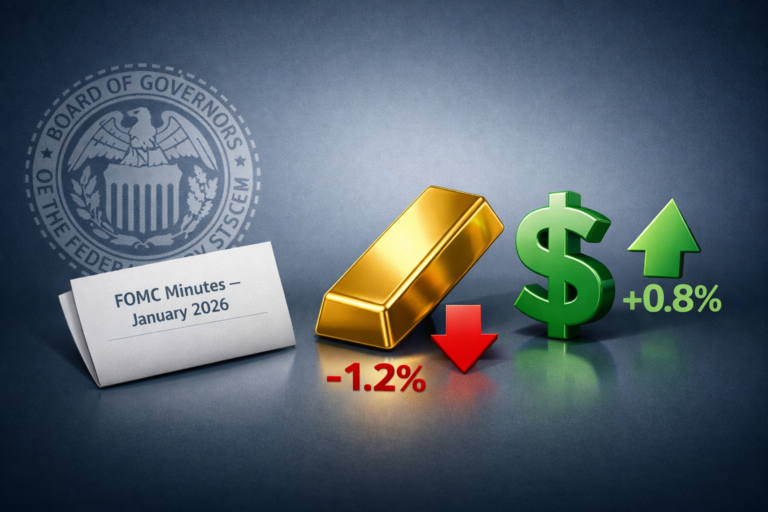
Following the minutes release, conviction grew that rate cuts remain distant. This assessment strengthened the US dollar against major currencies—a factor that traditionally exerts downward pressure on gold prices.
2. Short-Term Risk Appetite Declined
The absence of clear easing signals prompted investors to adopt a wait-and-see approach, reducing exposure to interest-rate-sensitive positions until upcoming inflation data provides clearer direction.
3. Technical Factors Compounded the Move
Dollar strength combined with rapid market reactions contributed to breaching short-term support levels, amplifying momentary selling pressure.
Reuters noted that gold’s reaction stemmed from diminished expectations for near-term rate cuts after digesting the Fed minutes—not from any new negative economic development.
Summary of Impact on Gold
| Factor | Effect on Gold |
|---|---|
| Hawkish Fed tone | Negative pressure |
| Delayed rate cut expectations | Reduced bullish momentum |
| Stronger US dollar | Traditional headwind |
| No new economic shocks | Limited structural change |
The direct cause of today’s gold pressure was the cautious, hawkish-leaning tone and postponed easing expectations—not an actual rate hike or sudden economic deterioration.
Placing This in Context
At Dhbna, we emphasize distinguishing between policy tone and policy action, and between short-term reactions and longer-term trajectories.
The January 2026 minutes represent a communication event that shifted market expectations without fundamentally altering the macroeconomic landscape. Gold responded to repriced probabilities rather than changed realities.
For investors seeking deeper understanding of how monetary policy intersects with precious metals, our gold price coverage provides ongoing context.
Summary
The January 2026 Federal Reserve minutes revealed a hawkish pause stance: rates held steady, future caution emphasized, and the possibility of further tightening left explicitly on the table.
Key points:
- Majority favored holding rates; only two members supported cuts
- Markets repriced first cut expectations from early 2026 to second half
- Dollar strengthened; gold faced temporary pressure
- No fundamental economic news drove the move—purely expectation adjustment
This episode illustrates how central bank communication can move markets independently of actual policy changes. Understanding this dynamic is essential for anyone following precious metals markets.