
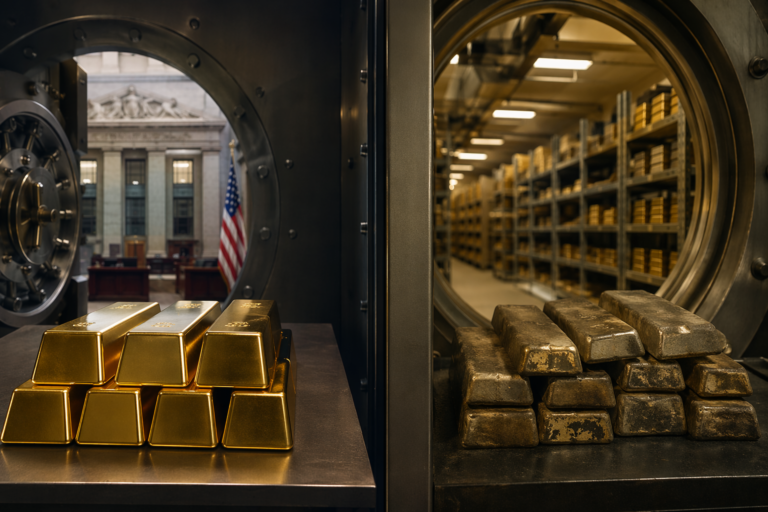
In early 2025, headlines across financial media announced that France had “sold” 129 tonnes of gold previously stored at the Federal Reserve in New York. The story spread quickly, and with it came a wave of misinterpretation. Some framed it as a retreat from gold. Others read it as a sign of weakness. Neither reading is accurate — and understanding what actually happened reveals something far more significant about the evolving role of physical gold in sovereign finance.
What France Actually Did
France did not reduce its gold holdings. The Banque de France held approximately 2,437 tonnes of gold before this operation — and it holds the same amount today. What changed is where the gold sits and what form it takes.
The operation involved selling 129 tonnes of older, non-standardized gold bars that had been held in custody at the New York Fed, then purchasing an equivalent quantity of gold meeting current international refinery and assay standards. The net effect on France’s reserve position: zero. The net effect on gold quality, location, and strategic positioning: substantial.
| Factor | Before Operation | After Operation |
|---|---|---|
| Total Reserve (tonnes) | 2,437 | 2,437 |
| Storage Location | Partially New York | Primarily Paris |
| Bar Standard | Mixed (older formats) | LBMA-compliant modern bars |
| Financial Result | — | +€12.8B exceptional gain |
Three Reasons Behind the Decision
1. Technical Compliance
An internal audit conducted in 2024 flagged a portion of France’s reserves as non-compliant with modern international bar standards — a technical issue that affects liquidity and tradability on global markets. Rather than physically shipping tonnes of metal across the Atlantic (expensive, slow, logistically complex), France opted for a paper exchange: sell old, buy new. Simpler. Faster. Cheaper. The result is a cleaner, fully fungible reserve.
For anyone building their foundational understanding of how central banks manage physical reserves, this kind of operational detail belongs squarely within the broader gold essentials conversation — the kind of structural knowledge that rarely makes headlines but consistently shapes long-term outcomes.
2. Financial Timing
The operation was executed during a period of historically elevated gold prices. The accounting impact was significant: France converted a €7.7 billion unrealized loss in 2024 into a €8.1 billion profit in 2025 — an exceptional gain of €12.8 billion by marking reserves to current market value through the exchange transaction.
This is not speculation or luck. It is sophisticated reserve management — the kind that treats gold not as a static asset gathering dust, but as an actively managed sovereign instrument.
3. Geopolitical Repositioning
Perhaps the most consequential layer of this story. Since the freezing of Russian central bank assets in 2022 — approximately $300 billion held in Western financial institutions — reserve managers across Europe have been quietly reassessing the risk of holding assets on foreign soil. France is the first to act formally and publicly. Germany and Italy are reportedly in internal discussions on similar reviews.
The message embedded in this move is unambiguous: physical gold held domestically is now considered a geopolitically safer asset than claims on foreign-held reserves, regardless of the counterparty’s historical reliability. This is a structural shift in thinking, not a transactional footnote. It connects directly to why gold’s role as a sovereign store of value continues to strengthen in an era of fragmented geopolitical trust.
What This Is Not
This is not a story about France losing confidence in gold. It is the opposite. It is a story about a sovereign nation actively optimizing its gold position — upgrading quality, repatriating custody, and capitalizing on favorable market conditions simultaneously.
If you have questions about how events like this are documented and sourced, or wish to understand our research methodology, visit our about page or reach out through our contact page.
Summary
| Key Point | Detail |
|---|---|
| Action Taken | Sold 129t old gold (NY Fed), bought 129t new gold (Paris) |
| Net Reserve Change | Zero — 2,437 tonnes maintained |
| Technical Reason | Upgrading to modern LBMA bar standards |
| Financial Gain | €12.8 billion exceptional profit |
| Geopolitical Signal | Repatriation driven by post-2022 asset-freeze concerns |
| Broader Implication | Physical gold gaining renewed sovereign importance globally |
France did not retreat from gold. It doubled down — more carefully, more strategically, and closer to home. That alone tells you something worth remembering.