The Moment Markets Recalibrated
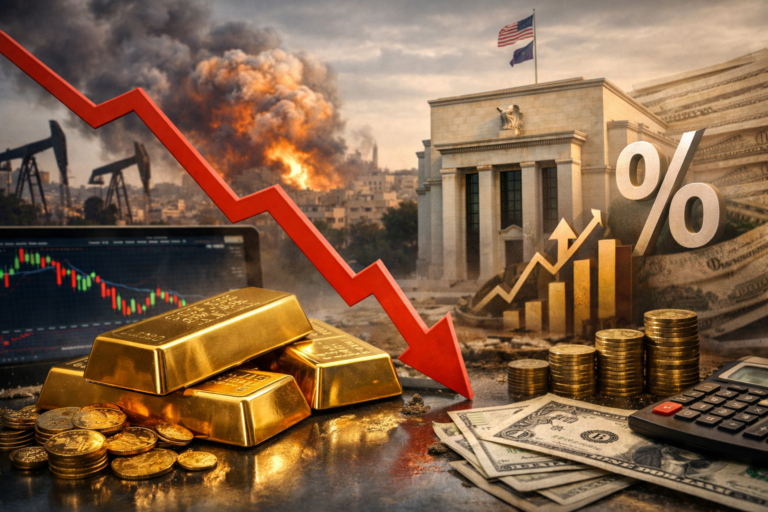
The decline in gold on March 18, 2026, despite ongoing conflict in the Middle East, wasn’t an anomaly. It was a strict reordering of market priorities.
The instant the Federal Reserve released its decision, the question shifted. It was no longer about geopolitical risk magnitude. It became about the cost of money in the global economy.
Gold, traditionally moving as a mirror of fear, found itself confronting a more rigid force: the repricing of the interest rate path.
“Hawkish Pause”: The Message Markets Captured
The Fed kept interest rates unchanged. However, the essence of the decision wasn’t in the hold itself—it was in the tone.
The official statement reflected:
- Clear caution about future moves
- No commitment to near-term rate cuts
- Persistent concern about inflation, especially amid rising energy prices
In market language, this wasn’t a neutral hold. It was a hawkish pause.
This signal alone was sufficient to reprice the entire rate curve and reduce expectations for cuts throughout 2026. Gold felt the impact immediately.
Understanding these dynamics requires familiarity with gold essentials that shape how the metal responds to monetary shifts.
Gold Versus “Opportunity Cost”
When expectations rise that rates will stay elevated, gold doesn’t need negative news to fall. It only needs the opportunity cost to increase.
A non-yielding asset becomes less attractive when:
- Bond yields climb higher
- Liquidity flows toward dollar-denominated assets
- Monetary policy pricing turns more conservative
This dynamic pushed gold below $5,000 per ounce, marking its lowest level in over a month.
Oil: From Gold’s Catalyst to Its Pressure
The most striking paradox of March 18 was this: the geopolitical factor that should support gold became part of the pressure against it.
War in the Middle East pushed oil above $100 per barrel. But this surge didn’t translate into net support for gold. Instead, it created:
| Factor | Market Impact |
|---|---|
| Higher oil prices | More persistent inflation |
| Inflation concerns | Pressure on central banks |
| Central bank response | Delayed rate cut expectations |
| Rate expectations | Downward pressure on gold |
The equation shifted:
Gold doesn’t react to war directly. It reacts to what war does to monetary policy.
Dollar and Yields: Liquidity Redistribution
The Fed decision coincided with dollar strength and rising Treasury yields—a clear signal that demand for dollar assets was returning.
This movement wasn’t merely technical. It expressed a liquidity shift toward:
- Instruments offering yield
- A tighter monetary environment
- Positions less reliant on hedging
In this environment, pressure on gold becomes a natural outcome, not an exception.
For those seeking deeper understanding, our about page explains our research methodology in tracking these market dynamics.
The Pivot Point: From Fear to Policy
What happened on March 18 can be summarized as a behavioral pivot:
Geopolitical fear was no longer the primary driver. The Fed’s response to that fear became the determinant.
Markets stopped asking:
“Is there a war?”
They started asking:
“Will this war delay rate cuts?”
This shift explains why gold retreated despite escalating risks.
The Chain Reaction
The session’s logic followed a clear sequence:
| Stage | Development |
|---|---|
| 1 | War escalation |
| 2 | Higher oil prices |
| 3 | More persistent inflation |
| 4 | Rates higher for longer |
| 5 | Pressure on gold |
This wasn’t a breakdown in gold’s safe-haven status. It was a demonstration that monetary policy can override geopolitical support when the stakes are high enough.
Summary
On March 18, 2026, gold didn’t lose its geopolitical backing. It encountered a stronger force: American monetary policy.
Key takeaways:
- The Fed’s hawkish pause repriced rate expectations for the entire year
- Rising oil prices fed inflation concerns rather than gold demand
- Dollar strength and higher yields redirected liquidity away from non-yielding assets
- Markets now prioritize policy response over raw geopolitical risk
The session demonstrated a critical truth about modern gold behavior: fear may trigger movement, but policy determines direction.