Contextual Overview
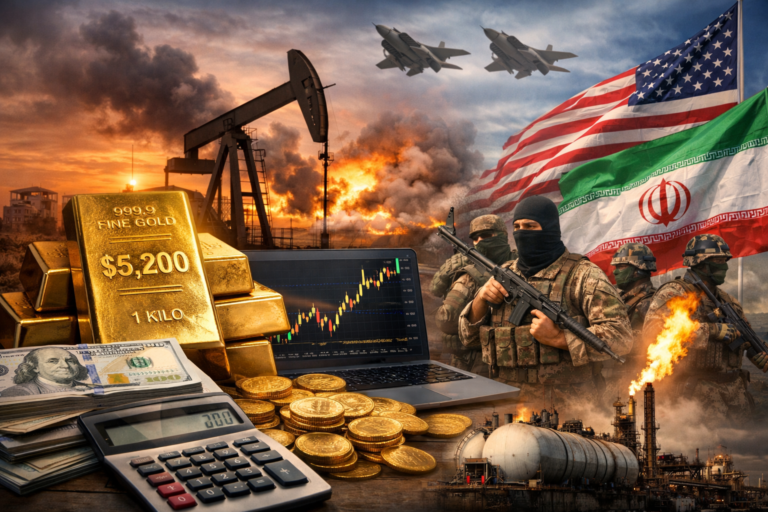
Gold prices surged past the $5,200 per ounce threshold during today’s spot trading session, driven by escalating tensions between the United States and Iran. The rally emerged amid stalled diplomatic negotiations and official statements suggesting that military options remain under consideration.
This movement coincided with declining equity indices and rising oil prices—a clear indication that global markets are actively repricing geopolitical risks into asset valuations.
What Happened?
Today’s gold rally reflects a convergence of political and market factors:
- Gold crossed the $5,200 mark during the Asian and European trading sessions
- News reports indicated no breakthrough in recent diplomatic discussions
- U.S. officials stated that “all options remain on the table”—language that markets interpret as maintaining escalation probability
According to Reuters commodity coverage, the movement was characterized as a “safe-haven rush” directly linked to elevated risk premiums.
Why Does Gold Respond Rapidly to Geopolitical Tensions?
Understanding gold fundamentals helps explain why the metal reacts swiftly to international crises. Historically, gold reprices through three primary channels during geopolitical stress:
Channel Breakdown
| Channel | Mechanism | Market Effect |
|---|---|---|
| Risk Premium | Investors reduce exposure to volatile assets | Capital flows toward defensive holdings |
| Oil-Inflation Link | Middle East tensions threaten energy supply routes | Higher inflation expectations boost gold appeal |
| Monetary Policy Expectations | Central banks hesitate to tighten during uncertainty | Lower rate expectations reduce gold’s opportunity cost |
The Iran Factor
Iran’s strategic position near the Strait of Hormuz—through which approximately 20% of global oil transits—amplifies market sensitivity to any U.S.-Iran confrontation. Energy supply disruptions would cascade through inflation channels, reinforcing gold’s role as a hedge against purchasing power erosion.
Historical Precedents
Past events demonstrate gold’s consistent response pattern to Middle Eastern tensions:
| Event | Date | Gold Response |
|---|---|---|
| Qasem Soleimani Assassination | January 3, 2020 | +2.5% within 48 hours |
| Gulf War Outbreak | August 1990 | Sharp rally over following weeks |
| Iran Nuclear Deal Exit | May 2018 | Gradual upward pressure |
These precedents reveal a consistent pattern: initial response is rapid and direct, while sustained momentum depends on whether escalation continues or diplomatic resolution emerges.
Technical Confluence
Beyond the news catalyst:
- Gold maintained position above the $5,180–$5,200 support zone
- This technical confirmation triggered additional buying momentum
- Previous resistance levels were breached, activating systematic purchase orders
The rally, therefore, represents a convergence of fundamental and technical factors—not purely a headline-driven spike.
Forward Scenarios
Scenario A: Continued Tension Without Containment
Risk premiums likely remain elevated, sustaining demand for safe-haven assets and supporting current price levels.
Scenario B: Diplomatic Progress or De-escalation
Risk premiums would compress, reducing hedging demand and potentially pressuring prices toward consolidation.
Key Monitoring Points
Investors and market observers should track:
- Official statements from Washington and Tehran
- Crude oil price movements and energy supply indicators
- U.S. Treasury yields as competing safe-haven benchmarks
- Federal Reserve communications regarding policy outlook
For those seeking deeper context on how gold behaves during market stress, our educational resources provide comprehensive background on these dynamics.
Summary
| Aspect | Key Takeaway |
|---|---|
| Price Action | Gold surpassed $5,200/oz on safe-haven demand |
| Primary Driver | U.S.-Iran tension and stalled negotiations |
| Secondary Factors | Oil price rise, equity decline, rate expectations |
| Technical Confirmation | Held above $5,180–$5,200 support zone |
| Outlook Dependency | Sustained movement requires continued escalation |
Conclusion
Today’s gold surge above $5,200 represents a clear return of geopolitical risk premium to global markets—not merely a transient technical event.
Markets are actively repricing the probability of escalation, and demand for safe-haven assets has increased accordingly.
At Dhahbuna, we distinguish between initial shock response and subsequent trajectory: gold responds immediately to tension, but sustained price direction depends on the event’s ultimate resolution.
Questions or observations? Reach out to our research team for further discussion.