Introduction: The Changing World Order Framework
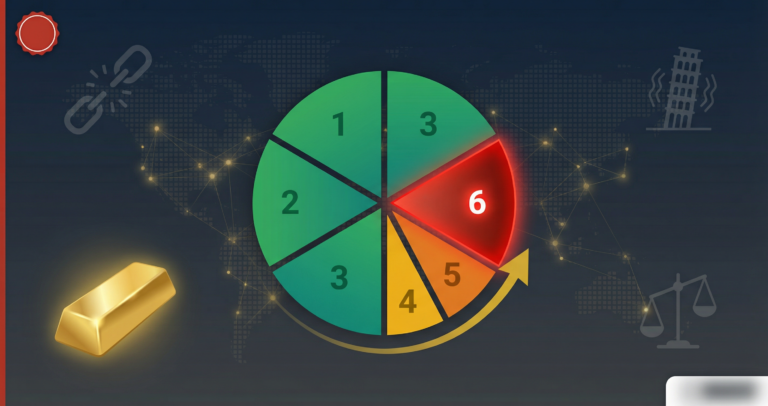
Ray Dalio, founder of Bridgewater Associates, has dedicated years to studying the rise and fall of empires through what he calls “The Great Cycle.” His research spans 500 years of history, examining patterns that repeat across civilizations. According to his framework, global systems move through six distinct stages, from new order establishment to eventual conflict and restructuring.
At Dhbna, we examine these macroeconomic frameworks to help readers understand how gold functions within broader economic cycles. Dalio’s current assessment suggests we are leaving Stage 5 (peak prosperity and power) and entering Stage 6—a period historically marked by significant upheaval.
The Three Forces Driving Stage 6 Transition
Dalio identifies three interconnected forces that push systems toward the conflict stage:
1. Unsustainable Debt Levels
When sovereign debt reaches levels that cannot be repaid through conventional means, governments resort to currency creation. This pattern has repeated throughout history, from the Roman Empire’s coin debasement to modern quantitative easing programs.
2. Internal Wealth Gaps
Growing disparities between rich and poor create social friction and political polarization. These internal conflicts weaken institutional stability and erode public trust in existing systems.
3. External Power Challenges
Rising powers challenge established ones, creating geopolitical tensions that can manifest as trade wars, financial conflicts, or military confrontations. Understanding these dynamics is fundamental to grasping gold’s historical role as a neutral asset.
Characteristics of Stage 6: What History Teaches Us
| Historical Period | Stage 6 Characteristics | Gold’s Behavior |
|---|---|---|
| Roman Empire Decline (3rd-5th Century) | Currency debasement, political instability | Gold hoarding increased significantly |
| Dutch Empire Transition (1780s) | War, debt crisis, loss of reserve currency status | Flight to hard assets |
| British Empire Post-WWI | Debt explosion, pound devaluation | Gold standard eventually abandoned |
| Post-2008 Era (Current) | Rising debt, geopolitical tensions, currency concerns | Central bank accumulation accelerating |
The consistent pattern across these periods shows that Stage 6 represents not merely economic decline, but fundamental restructuring of monetary systems.
The Defensive Portfolio Strategy for Uncertain Times
Dalio’s “All-Weather” portfolio concept, adapted for Stage 6 risks, emphasizes diversification across asset classes that respond differently to various economic scenarios:
| Asset Class | Suggested Allocation | Purpose |
|---|---|---|
| Global Equities | 30% | Geographic diversification away from conflict centers |
| Short-Term Bonds | 25% | Interest rate protection and liquidity |
| Gold | 20% | Currency hedge and systemic crisis protection |
| Commodities | 15% | Inflation protection |
| Cash | 10% | Opportunity fund for asset repricing |
This framework prioritizes capital preservation over aggressive growth—a philosophical shift that becomes crucial during regime transitions.
Why Gold Occupies a Central Position
Gold’s unique characteristic during Stage 6 periods is its independence from counterparty risk. Unlike bonds requiring government solvency or currencies dependent on central bank credibility, gold carries no “promise to pay.” This makes it what Dalio calls “the alternative money.”
For those beginning their journey into understanding precious metals, our gold essentials section provides foundational knowledge. Meanwhile, investors with physical holdings may find our jewelry care resources valuable for preservation purposes.
Geographic Diversification: A Critical Consideration
One often overlooked aspect of Stage 6 preparation is geographic diversification of assets. During periods of internal conflict or external wars, capital controls and asset seizures have historically occurred. Dalio emphasizes that holding assets across multiple jurisdictions reduces exposure to any single government’s policy decisions.
This principle extends beyond investment portfolios to include physical gold storage locations and banking relationships across stable regions.
Summary
Ray Dalio’s Great Cycle framework suggests we are transitioning from Stage 5 (peak order) into Stage 6 (conflict and restructuring). Three primary forces drive this shift: unsustainable debt, internal wealth disparities, and external power challenges. Historical precedents from Roman, Dutch, and British transitions show consistent patterns of currency instability during these periods. Dalio’s defensive portfolio allocates 20% to gold as protection against systemic risks, emphasizing that gold’s lack of counterparty risk makes it uniquely valuable when existing monetary frameworks face restructuring. The key insight is not predicting collapse, but recognizing that preserving capital becomes more important than generating returns during regime transitions.